Administration group🔗
Introduction to Administration group
This section provides information about Administration groups, which are used to control what NACVIEW administrators are allowed to see and do in the system. An Administration group is a term related to a set of administration accounts that share the same permissions and scope of management. In addition to its name, an administration group includes: an optional description, enabled status, full access status, assigned users, default object groups, and permission routers. All this information is important in the process of deciding which parts of the NACVIEW system, and which objects, a given administrator is allowed to view and manage.
System context: Administration groups are created individually (Add) or automatically during the import of other objects, e.g. identities or endpoints (such groups have the description Auto-created during import). By default, NACVIEW contains two built-in groups: Administrators, which has full access to the system, and Default Group. Built-in groups cannot be deleted. Each administration group can be linked to administration accounts (Users), default object groups, and to Sectors and other objects it is allowed to manage.
Operational Example: An organisation creates an administration group named Production Admins without full access and assigns to it the accounts of the production IT staff. The group is then linked to the Production sector, so its members can manage only the network devices and objects belonging to that sector, while the rest of the system remains hidden from them.
Toolbar🔗
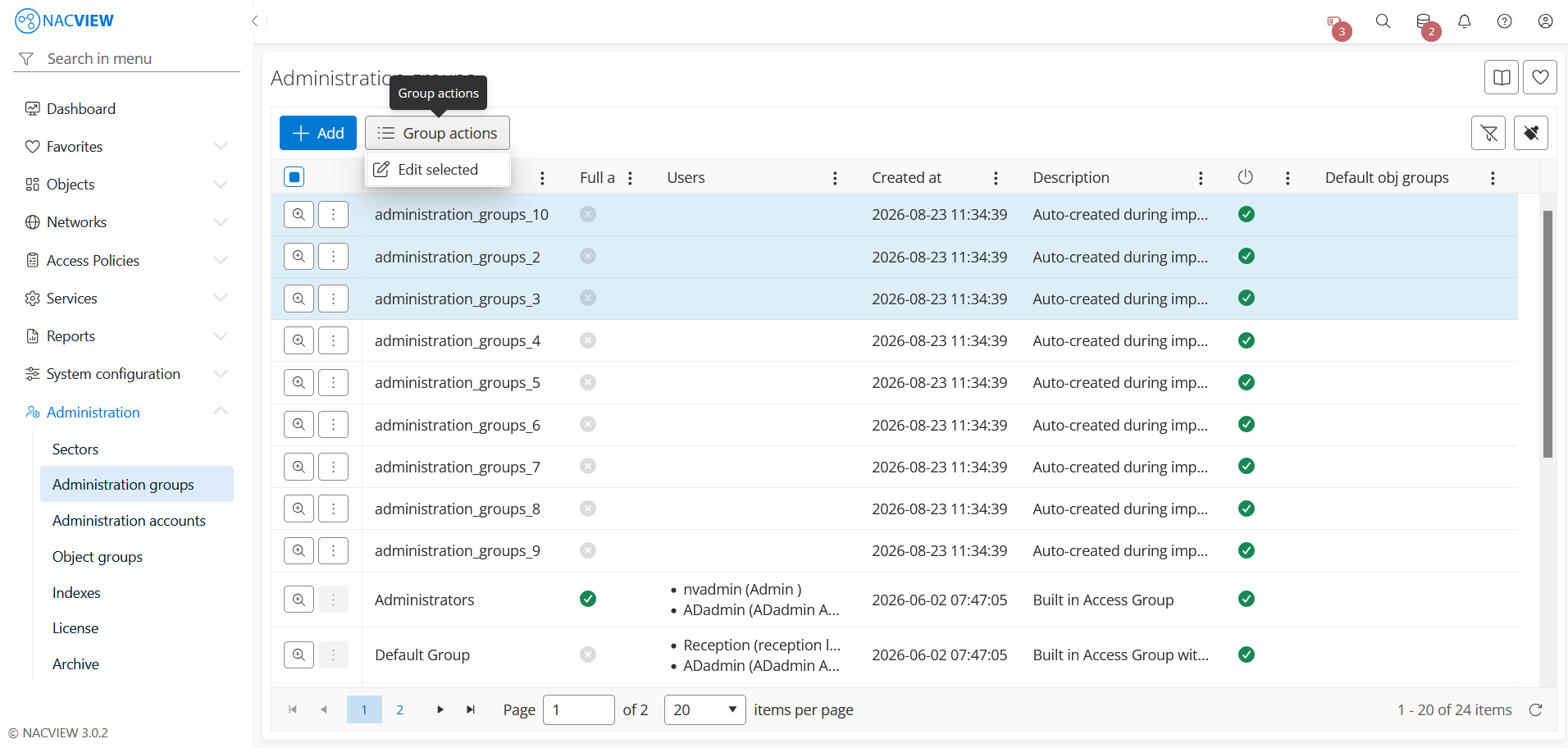
Add button is used to manually add a single new administration group.
Group actions button is used to perform an action on multiple selected administration
groups at once. Administration groups can be selected by holding the Ctrl or
Shift key while clicking. The available action is: Edit selected.
The administration group details panel🔗
The administration group details panel opens when a specific administration group is selected from the list (Details). It displays all information about the selected administration group in one place, in read-only mode. The top of the panel contains action buttons for the selected administration group (Edit, Permission, Archive), while below them the full set of the group’s attributes is shown, including Name, Enabled status, Description, and Full access.
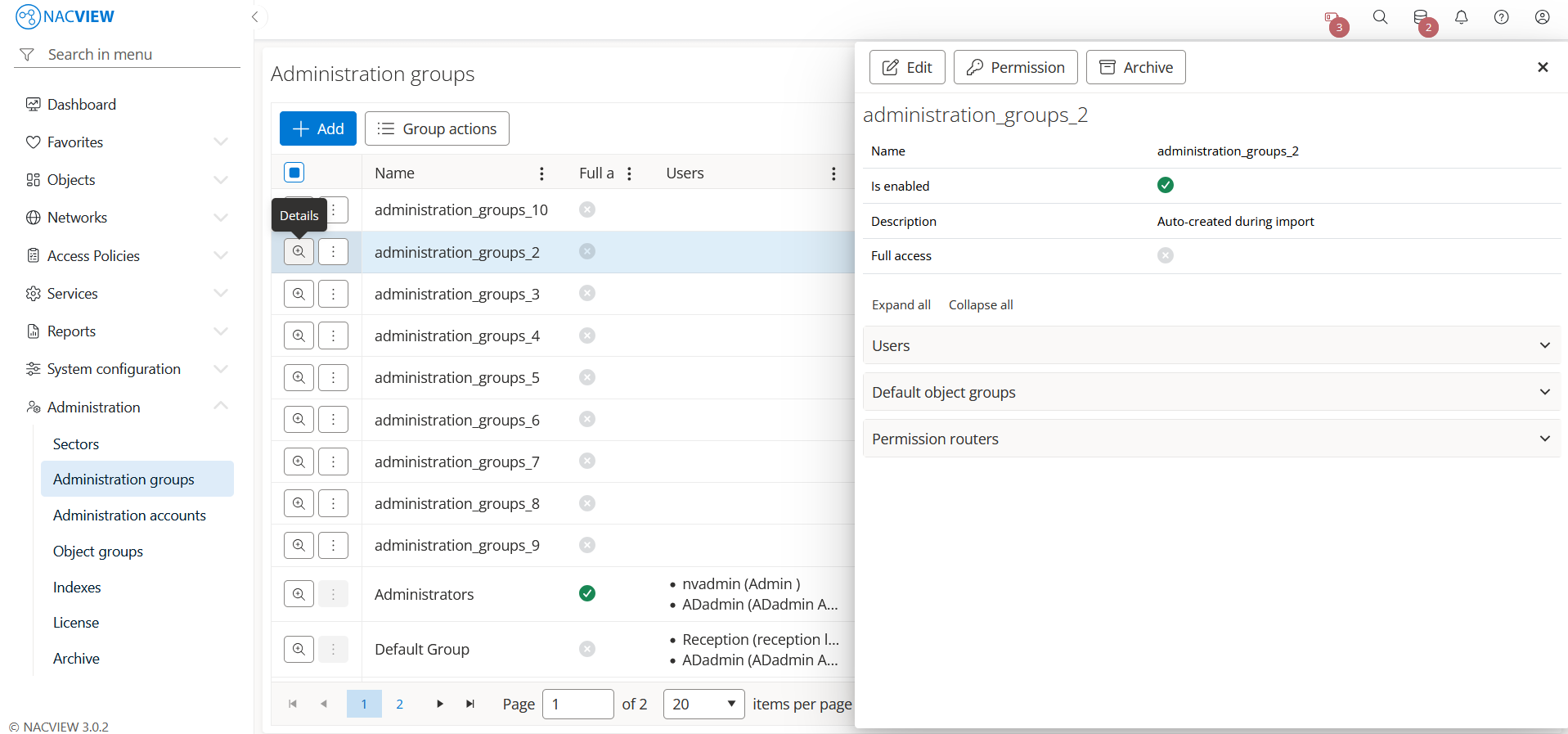
Edit button is used to edit the attributes of the selected administration group.
Permission button is used to define the permissions of the selected administration group, i.e. which parts of the NACVIEW system its members can access and which operations they can perform.
Archive button is used to display the archive records related to the selected administration group, showing when each record was created, by whom, from which IP address, and the object name and type.
Panels🔗
The following expandable panels are available at the bottom of the right-hand side of the details view:
Users - shows the administration accounts that are members of this group.
Default object groups - shows the object groups assigned by default to objects created by members of this group.
Permission routers - shows the permissions assigned to this group in a table. The rows list system areas grouped into categories (e.g. Objects, Services, Other), and the columns list operations: Create, View, List, Edit, Delete, and Custom. The cells show the assigned permission level, Full or Custom.
See also
For instructions on how to configure administration groups step by step, see Configuration Guides → Administration group configuration.
Views & Actions
/admin-guide/administration/access-group/permission-custom